5 assignments needed(500 each) due by 48 hours

 Here it is, let me know, thanks 

. Within 30 days of the date of this decision, the registrant must draft and submit a report that outlines a framework for obtaining consent. The report must be a minimum of two pages in length (minimum of 500 words). It should be submitted to  and must be satisfactory to the Committee. The report should include the following:
a) A description of how to determine if a client has capacity to consent;
b) An explanation of the importance of obtaining informed consent;
c) An outline of the registrant’s consent discussion with clients;
d) A description of the key elements of informed consent; and
e) An explanation of when consent should be obtained again.
3. Within 30 days of the date of this decision, the registrant must draft and submit a reflection paper on how the registrant will ensure compliance with Communication/Public Health Standard 4: Interview the Client to Obtain His/Her Treatment Goals. The reflection paper must be a minimum of two pages in length (minimum of 500 words). It should be submitted to  and must be satisfactory to the Committee. The reflection paper should address the following points:
3

DocuSign Envelope ID: 291A15AD-67EC-425E-A9FA-8AD8E7C21002
a) What the registrant has learned from reviewing Communication/Public Health Standard 4: Interview the Client to Obtain His/Her Treatment Goals;
b) What considerations the registrant has when setting goals with a client;
c) How the registrant involves a client in the goal setting process; and
d) What changes the registrant has made to the registrant’s practice to ensure
compliance with the Standards of Practice.
4. Within 30 days of the date of the decision, the registrant must draft and submit a reflection paper on how the registrant will ensure compliance with Communication/Public Health Standard 14: Client Health Record and the Personal Health Information Protection Act, 2004 (PHIPA). The reflection paper must be a minimum of two pages in length (minimum of 500 words). It should be submitted to  and must be satisfactory to the Committee. The reflection paper should address the following points:
a) An explanation of what the registrant has learned from reviewing Communication/Public Health Standard 14: Client Health Record and the Personal Health Information Protection Act, 2004 (PHIPA);
b) An explanation of the importance of storing records in a secure and confidential manner;
c) An explanation of why storing records in a vehicle can be inadequate;
d) What changes the registrant has made to the registrant’s practice to ensure
compliance with the Standards of Practice; and
e) A picture of the current file storage, demonstrating that the records are being
stored in a secure manner that maintains client confidentiality.
5. Within 30 days of the date of this decision, the registrant must draft and submit a reflection paper on the massage therapy scope of practice as laid out in section 3 of the Massage Therapy Act, S.O. 1991, c. 27 (the “Act”). The reflection paper must be a minimum of two pages in length (minimum of 500 words). It should be submitted to  and must be satisfactory to the Committee. The reflection paper should address the following points:
a) What the registrant has learned about the importance of understanding and working within the massage therapy scope of practice;
b) What steps the registrant takes to ensure that the treatment plans fall within the scope of practice;
c) What changes the registrant has made to the registrant’s practice to ensure compliance with the Standards of Practice and the Act; and
d) How the registrant incorporates the standards of practice into the registrant’s day-to-day massage therapy practice.
4

DocuSign Envelope ID: 291A15AD-67EC-425E-A9FA-8AD8E7C21002
6. Within 30 days of the date of this decision, the registrant must draft and submit a reflection paper on how the registrant will ensure compliance with Standard A4: Draping which is included in the Standard for Maintaining Professional Boundaries and Preventing Sexual Abuse. The reflection paper must be a minimum of two pages in length (minimum of 500 words). It should be submitted to and must be satisfactory to the Committee. The reflection paper should address the following points:
a) What the registrant has learned from reviewing Standard A4: Draping which is included in the Standard for Maintaining Professional Boundaries and Preventing Sexual Abuse;
b) What considerations an RMT should have when draping a client; and
c) What changes the registrant has made to the registrant’s practice to ensure
compliance with the Standards of Practice. 

Discussion 1: Classism


How often do you reflect upon the influence class has had on your life? Do you take your way of life for granted and assume others face the same opportunities or lack of opportunities that you face or are you keenly aware of the disparities that exist between the economic classes on a day-to-day basis? Your past personal experiences with classism likely vary from that of your colleagues as do your other cultural experiences. However, you now share in common the responsibility and identity of a social worker.

This week you meet the Hernandez family. As you observe the Hernandez family’s daily successes and challenges, reflect on how issues of privilege, power, and inequality converge into classism. As you get to know the Hernandez family this week, analyze your personal experiences with classism and identify the role of classism in working with social work clients.

Learning Objectives

Students will:

Analyze personal experiences with classism

Apply social work skills to address the impact of classism on clients

Analyze social work case studies related to classism from a multicultural social work perspective

Apply strategies for addressing classism in a case study

Learning Resources

Required Readings

Furman, R., Negi, N. J., Iwamoto, D. K., Rowan, D., Shukraft, A., & Gragg, J. (2009). Social work practice with Latinos: Key issues for social workers. Social Work, 54(2), 167-174. Retrieved from http://www.ncbi.nlm.nih.gov/pmc/articles/PMC2861823/

Liu, W. M., Pickett Jr, T., & Ivey, A. E. (2007). White middle-class privilege: Social class bias and implications for training and practice. Journal of Multicultural Counseling and Development, 35(4), 194-206.

Copyright 2007 by John Wiley & Sons. Used with permission of John Wiley & Sons via the Copyright Clearance Center.

Sherman, J., & Harris, E. (2012). Social class and parenting: Classic debates and new understandings. Sociology Compass, 6(1), 60-71

Adams, M., Blumenfeld, W. J., Castaneda, C., Catalano, D. C. J., DeJong, K., Hackman, H. W,… Zuniga, X. (Eds.). (2018). Readings for diversity and social justice (4th ed.). New York, NY: Routledge Press.

Section 3 Intro Classism (pp. 164-172)

Chapter 26, Class in America (pp. 173-182)

Chapter 28, Race, Wealth, and Equality (pp. 185-191)

Chapter 29, What’s Debt got to do with it? (pp. 192-195)

Chapter 34, Deep thoughts about class privilege (pp. 204-208) 

Chapter 41, “Classism from our mouths” and “Tips from Working-class activists” (pp. 229-233)

Chapter 42, Deep thoughts about class privilege (pp. 223-237) 

Plummer, S. B., Makris, S., & Brocksen S. M. (Eds.). (2014). Sessions: Case histories. Baltimore, MD: Laureate International Universities Publishing. [Vital Source e-reader].

“The Hernandez Family”

Some initial thoughts I’d like to share to get you started this week.  Classism is absolutely related to race, it also affects how society and institutions respond to the needs of people. Hence, we see the differentiation in treatment and service provision for certain neighborhoods.

SOCW 6051: Diversity, Human Rights, and Social Justice

Week 4 Discussion 1

Some initial thoughts I’d like to share to get you started this week.  Classism is absolutely related to race, it also affects how society and institutions respond to the needs of people. Hence, we see the differentiation in treatment and service provision for certain neighborhoods.

Discussion 1: Classism

Income and wages are measurable indicators of how prosperity is distributed amongst social class. Wealth, often determined by an individual’s net worth (assets minus liabilities), is another indicator that is used to determine class. Wealth for working class families is measured by their cars, savings, and home. As people improve their social and economic standing, wealth may include things like stocks and bonds, commercial real estate, and expensive jewelry.

Wealth is an important indicator because it spans past, present, and future generations. For example, compare the children of parents who can save money and leave an inheritance with children of parents who economically struggle and have few assets to pass on to the next generation. 

Historically, the creation and accumulation of wealth provides evidence of the legacy of racism, sexism, and discrimination and their role in determining class. Black/African Americans, women, and Hispanic/Latinos have historically been denied the means to obtain assets and grow wealth. Consider the impact of chronic marginalization on the Black/African American community’s ability to build wealth. While the income gaps between various ethnic groups may be decreasing, the gap between assets remains wide. 

Data from the Pew Research center show that the median wealth of Caucasian households is 20 times that of Black/African American households and 18 times that of Hispanic/Latinos households in the U.S. (Pew Research Center, 2011).

Class extends beyond wealth and other financial indicators. Class also includes details like the amount of free time you enjoy (because you are not working three jobs to make ends meet) or feeling like there is a “right” way to speak and act in order to be heard. For this Discussion, analyze how classism has impacted your life.

By Day 3

Post an analysis of how classism has factored into your life. Then, explain a strategy you might use as a social worker to address the impact of class and class differences on the lives of your clients.

Discussion 2: Power, Privilege, and Classism

Power, privilege, and classism are interconnected. The more privilege you enjoy, the more power you have to access opportunities that build wealth. The more wealth you can amass, the higher your social standing. It is important to note that having wealth is not an indictment. However, the privileges that have often led to inequalities in wealth distribution are real. As a social worker, you may find yourself working with clients who do not enjoy the privileges you knowingly or unknowingly enjoy. The more you understand your own relationship to power, privilege, and class, the better you will understand your clients’ realities. For this Discussion, review how classism is represented in the Hernandez family.

By Day 5

Post

  • An      explanation of how classism is demonstrated in the Hernandez video.
  • Identify      specific barriers to social services that the Hernandez family experiences      because of their class status (e.g., working poor).
  • Explain how      the intersection of class (e.g., working poor), ethnicity (e.g.,      Hispanic), and migration history (e.g., move from Puerto Rico to mainland)      may further impact the Hernandez’s experience.
  • Identity 2-3      strengths in the Hernandez family.
  • Provide      recommendations for how social workers might address issues of classism      present in the Hernandez case.
  • Explain how      recommendations would address class issues.

SCRIPT TO THE VIDEO THE MOST READ TO UNDERSTAND A BIT 


Hernandez Family Episode 4

Program Transcript 

(Sound like a supervisor and the social worker and is how it shows in the video setting down in the office speak. Social worker speaking to supervisor)

FEMALE SPEAKER: So how’s your week going? What’s happening with that 

Hernandez family? That’s their name, right? You were having some challenges 

there? 

FEMALE SPEAKER: They’ve missed four of their parenting classes, so far.

FEMALE SPEAKER: So they haven’t completed the parenting group? 

FEMALE SPEAKER: I have to call the ACS worker and let her know. They’re 

probably going to have to take the classes over again, and that’s going to be 

tough. The father misses overtime to come to the classes, and they really rely on 

that money to make ends meet. 

FEMALE SPEAKER: You have something else on your mind. Say it. 

FEMALE SPEAKER: I should have discussed this with you earlier. I don’t know 

why I didn’t. But perhaps they weren’t the best candidates for this to begin with. 

FEMALE SPEAKER: Because of their financial situation? 

FEMALE SPEAKER: Yes, and something else. I remember the ACS worker. And 

when she talked about wanting Elena, she kept calling them Mexicans. It was 

really derogatory the way she said it. 

FEMALE SPEAKER: So you’re saying she might have been biased into 

mandating that they take these classes? 

FEMALE SPEAKER: Yes. The more I think about it, she never talked to me 

about trying to understand the way they’re raising their children. And that 

Mexican remark, it just really wasn’t respectful. It’s like she had already made up 

her mind about people from that culture, and now they’re paying the price for it.

her mind about people from that culture, and now they’re paying the price for it.  

please follow the rubric 


Responsiveness to Directions

8.1 (27%) – 9 (30%)

Discussion posting fully addresses all instruction prompts, including responding to the required number of peer posts.

Discussion Posting Content

8.1 (27%) – 9 (30%)

Discussion posting demonstrates an excellent understanding of all of the concepts and key points presented in the text(s) and Learning Resources. Posting provides significant detail including multiple relevant examples, evidence from the readings and other scholarly sources, and discerning ideas.

Peer Feedback and Interaction

6.75 (22.5%) – 7.5 (25%)

The feedback postings and responses to questions are excellent and fully contribute to the quality of interaction by offering constructive critique, suggestions, in-depth questions, additional resources, and stimulating thoughts and/or probes.

Writing

4.05 (13.5%) – 4.5 (15%)

Postings are well organized, use scholarly tone, contain original writing and proper paraphrasing, follow APA style, contain very few or no writing and/or spelling errors, and are fully consistent with graduate level writing style.

week 3 project ts jr

Part A. Research Component: Software and Hardware Solutions

For Enterprise X to adopt a more strategic business model and embrace the inevitable paradigm shift to internetworking, it will need to do more than adopt a new Systems Architecture, it will also need to replace the components that make up its IT-Infrastructure. An obstacle for quick adoption of a new strategy is the legacy IT-Infrastructure. Analyze the challenges faced by the IT personnel in replacing legacy hardware and software. Moreover, analyze the pros and cons of the decisions regarding replacement. Bear in mind that there may be data issues and training issues to consider and address. Real-life cases that corroborate your findings and recommendations in this area will be very helpful in gaining acceptance for your plan. You should also analyze the positioning on McFarlan’s Strategic Grid in order to position the relative importance of these components with respect to cost and other factors that you might be able to identify.

To submit your assignment:

  • Use Microsoft Word to write a 750- to 1000-word position paper that describes your findings and recommendations.
  • You may include diagrams and illustrations to enhance and/or clarify your position on the technical issues addressed.
  • Follow APA guidelines to write the report and cite your sources as appropriate.
  • Save the report as SU_MIS6020_W3_lastname_firstinitial.docx and submit it to the Submissions Area by the due date assigned.

Part B. Presentation Component: IT/IS Models

You have already researched pertinent issues and prepared a Position Paper that will guide you in presenting your proposed strategy for Enterprise X. Now you must also prepare a new part of your strategy proposal for Enterprise X where you will evaluate the trade-offs with respect to costs and importance of the hardware and software components that make up the IT-Infrastructure of the company.

Keep in mind that each week you will work on a new component of your proposal presentation and, combined, these weekly presentations will become your final project proposal that will be published to the class in Week 5. Prepare a PowerPoint presentation with five to ten charts covering the aspects of your strategy described above.

Save your documentation as: SU_MIS6020_W3_Lastname_Firstinitial.pptx and submit it to the Submissions Area along with your Document by the due date assigned.

Note: There should be two documents in your Submissions Area, your position paper in Microsoft Word format and your proposal presentation component in Microsoft PowerPoint format.

Essay Social Psychology

PSY/400: Social Psychology

Wk 5 – Conflict Resolution Program [due Mon]

Wk 5 – Conflict Resolution Program [due Mon]

Assignment Content

  1. In this assignment, you will integrate the concepts of conflict resolutiongroup influence, and attribution to develop a program of conflict resolution to a current conflict situation.

    Identify a conflict between two groups, and obtain approval from your instructor.

    Write a 700- to 1,050-word paper in which you create a program to improve the relationship between two groups. Examples include between police and a community, managers and subordinates, the city council committee and a special interest group, and unions and management. Be specific in identifying what community, company, or organization you are writing about.

    Nature of the Conflict

    • Describe the context of the conflict. What kind of community or organization is this? Who are the stakeholders in the outcome of the conflict?
    • Identify the overt and covert issues presenting both sides.
    • Describe the effect the conflict has on the organization within which it exists and, if applicable, the surrounding community.
    • Identify attribution errors and how they will be addressed in the program.
    • Analyze the dynamics within each group and between groups. Who are the leaders? Does anyone stall or undermine the group? Is there a relationship between two subgroups?
    • Program Design
    • Apply the elements of conflict resolution.
    • Describe the central strategy you will use to resolve or diminish the conflict.
    • Provide at least one reference supporting the use of such a strategy.
    • Include a program component that employs social media.
    • Explain how you will address attribution errors between the groups.
    • Identify the elements of persuasion you will use in your program.
    • Create a presentation that you would give to sell your program to the company or organization where the conflict exists. The presentation should be accompanied by 10 Microsoft PowerPoint slides with speaker notes that include the following:
    • The goals of the program
    • The logistics of the program (schedule, location, and so on)
    • The content of the program (any worksheets, activities, or events)
    • Cite at least 4 references in your presentation, including the reference that demonstrates research support of your program strategy.

      Format any citations in your presentation according to APA guidelines.

      Submit your assignment.

      Resources:

    • Center for Writing Excellence
    • Reference and Citation Generator
    • Grammar and Writing Guides
    • Copyright 2019 by University of Phoenix. All rights reserved.

solution A+ work


roject implementation is arguably the most exciting stage of the project management process. It is during project implementation that project plans begin to come to life and assumptions are able to be tested and measured in real-life scenarios.

One of the outcomes of project implementation is a set of deliverables that typically includes a system diagram; a network diagram; a database design document, including an entity-relationship diagram, a data dictionary, and table definitions; a clearly articulated cybersecurity plan; and source code.

To complete this assignment, you will create:

  • A system diagram that shows, in graphic form, the components of your project.
  • Your system diagram should follow the system description you submitted in your Week 2 project plan (but may differ based on the research you have conducted since Week 2).
  • You may create your system diagram in Microsoft PowerPoint or a graphics program of your choice.
  • A network diagram that shows, in graphic form, the flow of data within your project.
  • Your network diagram should follow the network description you defined in the Week 2 project plan (but may differ based on the research you have conducted since Week 2).
  • You may create your network diagram in Microsoft PowerPoint or a graphics program of your choice.
  • A database design document, including an entity-relationship diagram, a data dictionary, and table definitions, representing all of the data that must be stored and maintained within the context of your project and how that data is organized.
  • A clearly articulated cybersecurity plan that explains how you plan to secure project data and processes.
  • Source code (maybe partial) for at least one software application.
  • Your source code may be implemented in HTML/JavaScript, Java, C++, or another programming language.
  • Download and unzip the HTML/JavaScript/CSS sample code files for an example of a partial software application implementation.
  • A quality assurance and software test plan.
  • Download the Software Test Plan for an example of what information is typically included and how it is typically organized in a software test plan.

Note: All deliverables must be portfolio ready, which means as complete and error-free as possi

SIM Scenario (Due 24 hours)


1) complete the template (Follow the 3 x 3 rule: minimum three paragraphs per part)

             Part 1: Minimum Complete the template

2)¨******APA norms

          All paragraphs must be narrative and cited in the text- each paragraphs

          Bulleted responses are not accepted

          Dont write in the first person 

          Dont copy and pase the questions.

          Answer the question objectively, do not make introductions to your answers, answer it when you start the paragraph

3)****************************** It will be verified by Turnitin (Identify the percentage of exact match of writing with any other resource on the internet and academic sources, including universities and data banks) 

********************************It will be verified by SafeAssign (Identify the percentage of similarity of writing with any other resource on the internet and academic sources, including universities and data banks)

4) Minimum 3 references per part not older than 5 years

5) Identify your answer with the numbers, according to the question. Start your answer on the same line, not the next

Example:

Q 1. Nursing is XXXXX

Q 2. Health is XXXX

__________________________________________________________________________________

Part 1: Curriculum Design and Simulation  (Check Sample, sample  1 and 2)

SIM Scenario 

Topic: Unplanned endotracheal tube dislodgement in the ICU in a respiratory failure patient

Target Audience: Nurses for airway emergencies

With the massive surge of patients requiring intubation and mechanical ventilation that is occurring with this COVID-19 pandemic, statistically we should also expect an increase in number of incidents of UE. According to the Center for Disease Control (CDC, 2020), 60%–75% of COVID-19 patients admitted to the ICU present with ARDS or respiratory failure, and it is likely that these patients required intubation, so, is important to prepare bedside nurses for airway emergencies.

Reference

CDC. (2020). Characteristics of Hospitalized COVID-19 Patients Discharged and Experiencing Same-Hospital Readmission – United States, March–August 2020. Retrieved January 25, 2021, from https://www.cdc.gov/mmwr/volumes/69/wr/mm6945e2.

This week, submit your SIM scenario. 

The purpose of this assignment is to plan and develop a valid 15- to 20-minute simulation scenario based on current evidence and integrating effective teaching strategies based on instructional and learning assessment methodologies. 

It is highly recommended that you follow the simulation template attached (File 1)

The following criteria must be incorporated into the simulation scenario and are included in the attached template (File 1):

SIM Scenario 

Topic: Unplanned endotracheal tube dislodgement in the ICU in a respiratory failure patient

Target Audience: Nurses for airway emergencies

Title

1. SIM patient details

2. Estimated scenario time

3. Estimated debriefing time

4. Several paragraphs that summarize the scenario

5. Educational rationale

7. Learning objectives and the scenario focused objectives

8. A list of the standards of nursing care that the simulation focuses on; you can use the NCLEX chart in your text, or national nursing standards such as BSN or MSN essentials. 

9. A list needed supplies and equipment

10. A description of the environment and the prior learning/skills needed

11. A list and description of the number of students involved, their roles, and the instructor role

A list of the patient’s vital signs, cues, prompts, and details of the scenarios

11. The expected student interventions and the correct treatment using a SIM progression outline

12. Several guiding questions for the student during debrief

13. The story must be believable and  must represent a realistic patient experience. The physiological changes in the patient must be authentic.  Nursing interventions must be realistic and within the scope of practice, and represent best practices and standards of care.  Family members’ reactions and behaviors must be represented in a realistic manner in response to the patient’s condition.

Leadership 2 (Due 24 hours)


1) Minimum 5 full pages (No word count per page)- Follow the 3 x 3 rule: minimum three paragraphs per part.

            Part 1: Minimum 2 pages

            Part 2: minimum 3 pages

    Submit 1 document per part

2)¨******APA norms

          All paragraphs must be narrative and cited in the text- each paragraph

          Bulleted responses are not accepted

          Don’t write in the first person 

          Don’t copy and paste the questions.

          Answer the question objectively, do not make introductions to your answers, answer it when you start the paragraph

Submit 1 document per part

3)****************************** It will be verified by Turnitin (Identify the percentage of exact match of writing with any other resource on the internet and academic sources, including universities and data banks) 

********************************It will be verified by SafeAssign (Identify the percentage of similarity of writing with any other resource on the internet and academic sources, including universities and data banks)

4) Minimum 4 references per part not older than 5 years

All references must be consistent with the topic-purpose-focus of the parts. Different references are not allowed.

5) Identify your answer with the numbers, according to the question. Start your answer on the same line, not the next

Example:

Q 1. Nursing is XXXXX

Q 2. Health is XXXX

6) You must name the files according to the part you are answering: 

Example:

Part 1.doc 

Part 2.do

__________________________________________________________________________________

Part 1: Leadership

You have just come from your 6-month performance evaluation as a new charge nurse.  While your supervisor stated that he was very pleased in general with how you are performing in this new role, one area that he suggested you work on was to learn to be calmer in hectic clinical situations.  He suggested that your anxiety could be transmitted to coworkers and subordinates who look to you to be their role model.  He feels that you are especially anxious when staffing is short and that at times you vent your frustrations to your staff, which only adds to the general anxiety level on the unit.

1. Create a specific plan of  10 things you can do to bolster your emotional intelligence in terms of self-regulation during stressful times. Explain them.

Part 2: Leadership

You are the night shift charge nurse on a busy surgical unit in a large, urban teaching hospital.  Surgeries occur around the clock, and frequently, noise levels are higher than desired because of the significant number of nurses, physicians, residents, interns, and other health-care workers who gather at the nurses station or in the halls outside of patient rooms.  Today, the unit manager has come to you because the hospital’s score on the Centers for Medicare and Medicaid Hospital Consumer Assessment of Healthcare Providers and Systems (hCahPS) survey for the category Always Quiet at Night falls far below the desired benchmark.  She has asked you to devise a plan to address this quality of care issue.  The management goal in this situation is to achieve an HCAHPS score on Always Quiet at Night that meets the accepted best practices benchmark, thus assuring that patients get the rest they need to promote their recovery.  The leadership goal is to foster a shared commitment among all health-care professionals working on the unit to achieve the Always Quiet at Night goal.

Assignment:

1. Identify five management strategies you might use to address the problem of excessive noise on the unit at night. 

For example, your list might include structural environmental changes or work redesign.

2. Identify five leadership strategies you might use to promote buy-in of the Quiet at Night initiative by all health-care professionals on the unit.  

3. How will you inspire these health-care professionals  to work with you in achieving this critically important goal?  

a. What incentives might you use to reward behavior conducive to meeting this goal? Why these incentives?

4. Discuss whether you feel this goal could be achieved by employing only the management strategies you identified. Why?

5. Could it be goal achieved only with the implementation of leadership strategies for team building? Why?

Research Plan


Research Plan

The president of a women’s clothing store chain targeting 25 to 40 year old working professionals is concerned about a four-year trend of declining profits. The stores have been characterized as rather conservative over the years with respect to their product line, store décor, and advertising. They have consistently avoided trendy clothes, for example. Their market is now becoming extremely competitive because several aggressive fashion stores are expanding and aiming at the young, fashion-conscious buyer. As a result of this competition, and the disappointing profit trend, the president is considering making the product line appear less conservative and more oriented toward the young buyer. Before making such a risky change, the president feels it to be prudent to conduct some marketing research to learn the exact status of his chain.

What should be the research purpose? Compose a set of three research questions that would be helpful and justify them. Would you use primary or secondary sources, and why? Who would perform this research? What ethical considerations should be kept in mind?

This paper should be four to six pages long and contain at least six sources, four of which must be primary sources, including the textbook.

See the Chapters 1 to 4 in your textbook regarding this case. Some discussions that may be useful include those on the Ethics of Marketing Research, Marketing Research Suppliers, the Marketing Research Process, and Types of Research.

This assignment is worth 9 points of the total course grade.

ET Wk6 – s

Research paper: 5 full pages

Threat Modeling

A new medium-sized health care facility just opened and you are hired as the CIO. The CEO is somewhat technical and has tasked you with creating a threat model. The CEO needs to decide from 3 selected models but needs your recommendation. Review this week’s readings, conduct your own research, then choose a model to recommend with proper justifications. Items to include (at a minimum) are:

  • User authentication and credentials with third-party applications
  • 3 common security risks with ratings: low, medium or high
  • Justification of your threat model (why it was chosen over the other two: compare and contrast)

You will research several threat models as it applies to the health care industry, summarize three models and choose one as a recommendation to the CEO in a summary with a model using UML Diagrams (Do not copy and paste images from the Internet). In your research paper, be sure to discuss the security risks and assign a label of low, medium or high risks and the CEO will make the determination to accept the risks or mitigate them. Your paper should meet the following requirements:

  • Be approximately 5 full pages in length, not including the required cover page and reference page.
  • Follow APA 7 guidelines. Your paper should include an introduction, a body with fully developed content, and a conclusion.
  • Support your answers with the readings from the course and at least two scholarly journal articles to support your positions, claims, and observations, in addition to your textbook. The UC Library is a great place to find resources.
  • Be clearly and well-written, concise, and logical, using excellent grammar and style techniques. You are being graded in part on the quality of your writing.

Complete Lab Report

Introduction

This lab will require the student to create solutions of iron and aluminium by using electrolysis. Students will then observe the voltage created in a number of galvanic cells and create a reactivity order. 

Materials

  • 9V battery
  • Alligator clips * may have come with multimeter / voltmeter
  • Aluminum foil
  • Cups / Beakers – 7 – regardless of vessels used, they are called “beakers” in this lab
  • CuSO4  – 30mL 1M CuSO4 solution or 7.5g solid CuSO4 
  • Finish nails – 5 *Some metal paper clips may work
  • Graphite pieces – 8 – for mechanical pencils (something like this – the size isn’t relevant for this lab but you will need several sticks. If possible, choose a size for a pencil you already own)
  • NaCl – 3-5g (table salt)
  • Paper towel
  • Pen for labeling cups / beakers
  • Scissors
  • Voltmeter / Multimeter (HarborFreight $6.40, Amazon $10.26, Walmart $8.09, AliExpress (choose EMS ePacket it will take about 2 weeks) $5.04
  • Water – tap water

Galvanic Cells

Video: https://youtu.be/R9gHUh48KDY

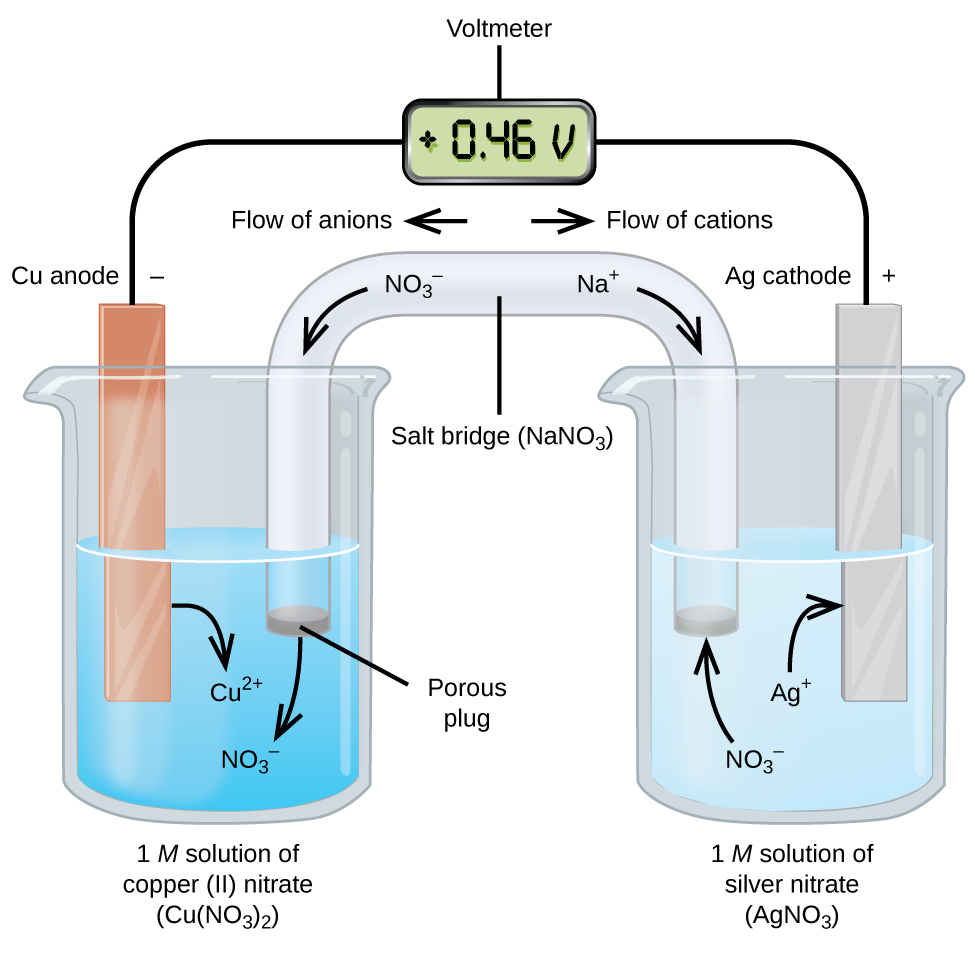
A galvanic cell is a spontaneous production of a redox reaction. This is an electrochemical cell that will be demonstrated in the lab. A galvanic cell has an anode (oxidation reaction) and a cathode (reduction reaction).  The electrons flow through a salt bridge which does not react with other ions in solution.

The salt bridge could be a paper towel or filter paper soaked in an ionic solution or it can be a porous disk between the anode and cathode chambers.

Each half reaction has a standard reduction potential that can be looked up on a table. The standard reduction potentials can be used to calculate the cell potential, in Volts, of a galvanic cell.

Eocell = Eocathode – Eoanode

For a cell that is made up of Zinc and Cobalt, the half reactions and their standard reduction potentials are:

Zn2+(aq) + 2e- →  Zn(s)  Eo = –  0.76V

Co2+(aq) + 2e- →  Co(s)  Eo = –  0.28V

Since cobalt has a more positive reduction potential, it will be the reduction reaction at the cathode. Zinc will be the oxidation reaction at the anode. The Eocell can then be calculated as:

Eocell = Eocathode – Eoanode

Eocell = EoCo – EoZn

Eocell = (-0.28) – (-0.76)

Eocell = +0.48V

Nernst 

Video: https://youtu.be/mNPrwKyOak0

Calculating redox potentials and determining spontaneity in non-standard conditions requires the use of the Nernst equation. (at 25 oC the following equation applies)

E = Eo – (0.0592V/n) logQ

Recall that Q is determined by the concentration of the products over the concentration of reactants. For this course, you should have only one species for each of the products and the reactants.

For example, What is the potential of a cell made up of Zn/Zn2+ and Cu/Cu2+ half-cells at 25oC if [Zn2+] = 2.5M and the [Cu2+]= 0.25M? 

First step is to determine the reaction equation by looking at the standard reduction potentials to determine which species is reducing and which is oxidation.

Zn2+ + 2e- → Zn   Eo = -0.76

Cu2+ + 2e- → Cu   Eo = +0.34

Copper is the cathode because it is more positive. Now calculate the Eo.

Eocell = Eocathode – Eoanode

Eocell = EoCu – EoZn

Eocell = (0.34) – (-0.76)

Eocell = 1.10V

There are 2 electrons being transferred, n=2. Complete the Nernst Equation.

E = Eo – (0.0592V/n) log([Zn2+]/[ Cu2+])

E = 1.10 – (0.0592V/2) log(2.5M/0.25M)

E = 1.10 – 0.0296V

E = 1.07 V

Concentration Cell

A concentration cell is a galvanic cell that is composed of the same species, but in different concentrations. For example, a cell composed of 2 zinc electrodes with one cell holding 0.10M zinc sulfate and the other holding 1.0M zinc sulfate can be calculated using a form of the Nernst equation as well.

E = Eo – (0.0592V/n) log([Zn2+]dilute/[ Zn2+]concentrated)

E = 0V – (0.0592V/2) log(0.1/1.0)

E = -0.030V

Electrolysis will be used to create solutions of iron and aluminum. Electrolysis is the use of electricity to force a reaction that otherwise is nonspontaneous.

Galvanic cells will then be set up and studied.

A Concentration cell of CuSO4 will also be studied.

Familiarize yourself with voltmeter and set it up

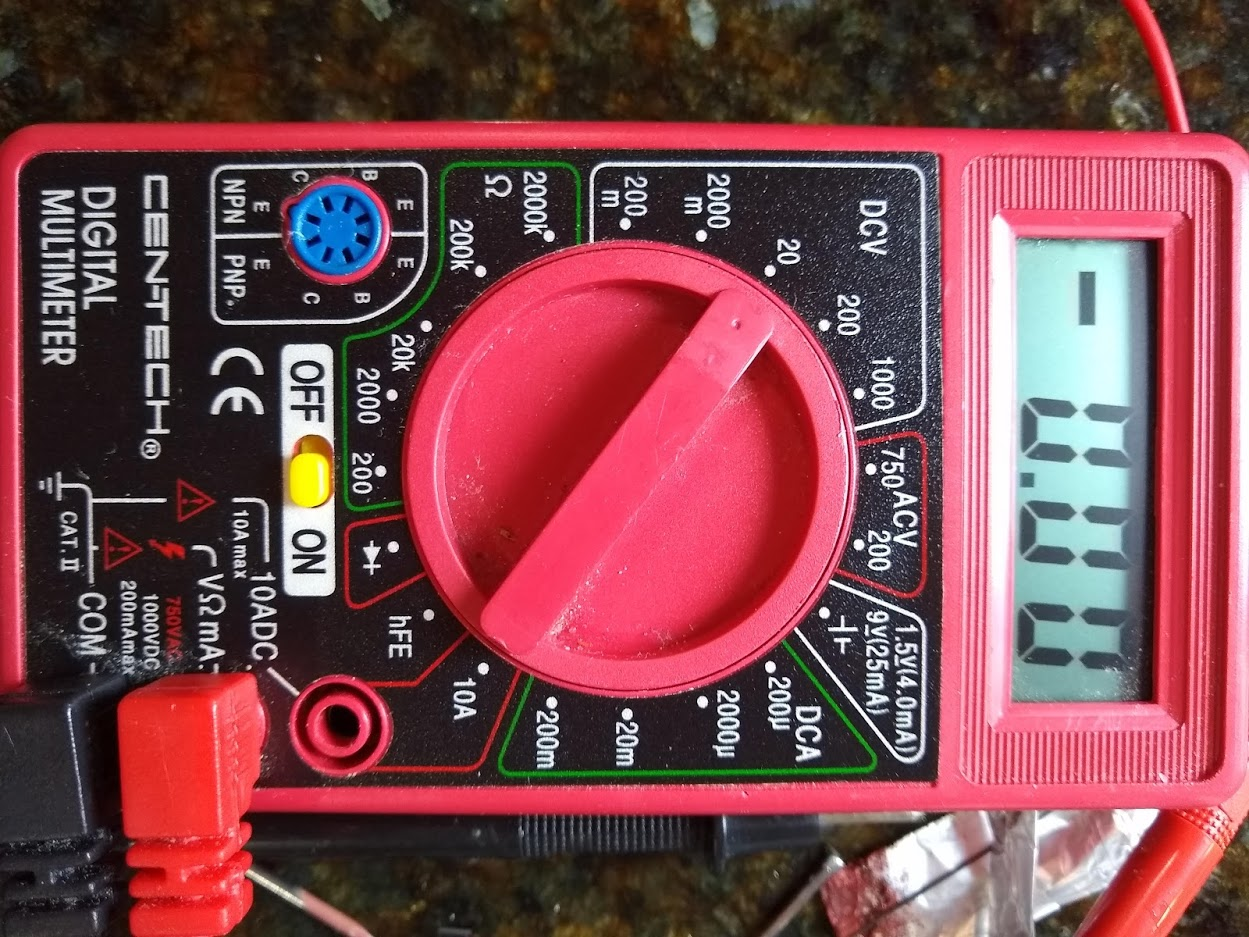
  1. Prepare the Voltmeter or Multimeter (referred to as voltmeter). 
  2. Insert batteries, if needed. 
  3. Insert the leads appropriately and turn the dial to 20V. This is the setting that will display volts. Turn the voltmeter on.
  4. Test the battery that will be used later in the lab by placing the red lead on the positive terminal of the 9V battery and the black lead on the negative side. 
  5. Verify that the display shows approximately 9V.
  6. If the display shows less than 6V, get a new battery and verify the display again.

Make solutions and anodes

        When making these solutions, be sure to record your observations for the Discussion section.

  1. NaCl solution
  2. Tare a small beaker on the scale.
  3. Mass approximately 4g of table salt into the beaker.
  4. Add approximately 125mL of clean tap water to the beaker.
  5. This is the NaCl solution
  6. Graphite Electrodes
  7. Gather mechanical pencil “lead” refills.
  8. Snap approximately in half to create 12 pieces that are approximately 1 inch long.
  9. These are the Graphite Electrodes.
  10. CuSO4 Solution from solid CuSO4
  11. Tare a small beaker on the scale.
  12. Mass approximately 8g of CuSO4  into the beaker.
  13. Add approximately 40mL of NaCl solution to the beaker.
  14. This is the CuSO4 solution
  15. CuSO4 solution – purchased as 1M CuSO4
  16. Measure 40mL of premade 1M CuSO4 in a clean beaker.
  17. Add a heavy pinch of salt to the solution.
  18. This is the CuSO4 solution
  19. Cu Electrodes
  20. Measure approximately 10mL of CuSO4 solution into a clean beaker or into the 10mL graduated flask.
  21. Place 1 Graphite electrode in the red alligator clip.
  22. Place 1 Graphite electrode in the black alligator clip.
  23. Attach the red alligator clip to the positive side of a 9V battery.
  24. Attach the black alligator clip to the negative side of a 9V battery.
  25. Insert the electrodes into measured CuSO4 solution prepared and measured in (a) of the Cu electrode section.
  26. Allow this to react for approximately 1 minute.
  27. Make sure to submerge the electrode on the black alligator clip as much as possible without getting the alligator clip wet.
  28. Place the electrode that is now coated in red copper aside. 
  29. This is the Cu electrode.
  30. Repeat b-i until there are 3 Cu electrodes prepared.
  31. Al Electrodes
  32. Cut Aluminum foil into 5 pieces approximately 1cm x 6cm.
  33. These are the Al Electrodes.
  34. Al3+ Solution
  35. Measure 30mL of NaCl solution into a clean beaker.
  36. Place 1 Aluminum electrode in the red alligator clip.
  37. Place 1 Graphite electrode in the black alligator clip.
  38. Attach the red alligator clip to the positive side of a 9V battery.
  39. Attach the black alligator clip to the negative side of a 9V battery.
  40. Insert the electrodes into the NaCl solution prepared and measured in (a) of the Al3+ section. 
  41. Allow this to react for approximately 3 minutes.
  42. Dispose of both electrodes used.
  43. This is the Al3+ solution.
  44. Fe Electrodes
  45. Gather 5 finish nails.
  46. These are the Fe Electrodes.
  47. Fe2+ Solution
  48. Measure 30mL of NaCl solution into a clean beaker.
  49. Place 1 Fe electrode in the red alligator clip.
  50. Place 1 Graphite electrode in the black alligator clip.
  51. Attach the red alligator clip to the positive side of a 9V battery.
  52. Attach the black alligator clip to the negative side of a 9V battery.
  53. Insert the electrodes into the NaCl solution prepared and measured in (a) of the Fe2+ section. 
  54. Allow this to react for approximately 2 minutes.
  55. Dispose of both electrodes used.
  56. This is the Fe2+ solution.
  57. Take a picture of all of your prepared solutions and electrodes.

Testing Reactivity

Solids in Liquids

  1. Attach one side of the red alligator clip lead to the red voltmeter lead.
  2. Attach one side of the black alligator clip lead to the black voltmeter lead. 
  3. Create a data table in the Results section of your lab report document to record all of the observed voltages. 
  4. Set up and record the voltage readings (highest viewed voltage during about 1 minute) of the following combinations. The solid metal electrode should be in the black alligator clip. There should be a fresh graphite electrode in the red alligator clip for each combination. Use a new metal electrode for each test. For the Fe electrodes, it is possible that you will need to briskly rub the surface of the electrode with a rough paper towel to remove the oxide layer. If you do not get expected readings, try to clean the electrode and retry the voltage readings. 
  5. Record any physical observations as well as the voltage.

Fe2+ solution

Al3+ solution

CuSO4 solution

Fe electrode

Al electrode

Cu electrode

Liquids and Liquids

  1. Create a data table in the Results section of your lab report document to record all of the observed voltages. 
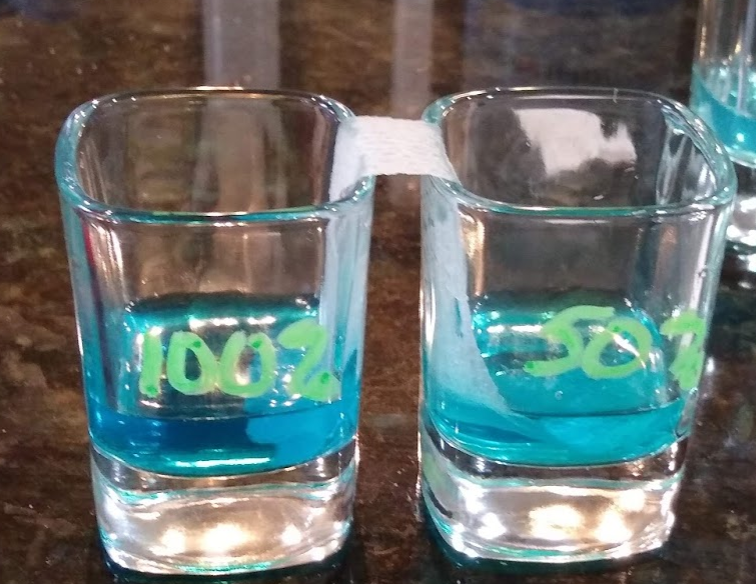
  2. Measure 10mL of CuSO4 solution into a clean beaker. This is the 100% solution.
  3. Measure 5mL of NaCl solution into the 10mL graduated cylinder. Add 5mL of CuSO4 solution to the graduated cylinder. Pour the solution into a clean beaker. This is the 50% solution.
  4. Measure 9mL of NaCl solution into the 10mL graduated cylinder. Add 1mL of CuSO4 solution to the graduated cylinder. Pour the solution into a clean beaker. This is the 10% solution.
  5. Make 3 salt bridges
  6. Cut strips of paper towel that will be long enough to touch the liquid level of two solutions when the beakers are next to one another.
  7. Dip these paper towel pieces into the NaCl solution and gently squeeze the excess solution out. 
  8. Set these ion soaked paper towels aside. 
  9. These are the salt bridges.
  10. Place two beakers next to one another and drape 1 salt bridge over the edge of the beakers so that one side is in the 100% solution and the other side of the salt bridge is in the 50% solution.

  1. Insert clean graphite electrodes in each alligator clip. 
  2. Place the graphite electrode attached to the black lead in the more concentrated solution. The graphite electrode with the red lead should be inserted into the less concentrated solution.
  3. Without touching the salt bridge to the electrode, record the voltage reading (instantaneous high read allowing for about 1 minute of stabilization time) of the concentration cell.
  4. Dispose of the salt bridge. Set the graphite electrodes near each solution used. 
  5. Repeat the above steps 6-9 for the other combinations; 100% | 10% & 50% | 10%

Concentration Cell Data Treatment

The Nernst equation will be applied. 

  1. Calculate the Eo of the cell. (hint: the oxidation and reduction equations are likely to be equal and opposite one another! This is not a trick question.)
  2. Determine n for this cell. (n = moles of electrons being transferred)
  3. Calculate RT/F, the constant part. T should be standard room temperature. Either insert an actual reading or 298K. 
  4. The concentrations are relative. Use 100, 50, 10.  Which is the one in the numerator? The one that produces the sign you saw on your voltmeter.