discussion 14

This is a required assignment worth 15 points (15-points/1000-points). Assignment must be submitted by the due date. No late assignments are allowed. Please discuss the following topics and provide substantive comments to at least two other posts. Select from the following list two topics and discuss. Use only 50-words max per topic to discuss and present your answer.  The discussion questions this week are from Chapter 14  (Jamsa, 2013).Chapter 14 topics:

  • Define and describe the mobile web.
  • Describe the different generations of cell phones.
  • Describe how smartphones differ from ordinary cell phones.
  • Select a mobile or traditional website that interests you. Describe the site in terms of the ecosystem that makes up the site’s user experience.
  • Describe how web pages differ from apps and how apps differ from widgets.
  • Discuss why developers say that HTML5 will drive mobile solutions.
  • Describe some development best practices for designing solutions for the mobile cloud.

Note: You are required to use at least two sources (besides your textbook) to answer the above questions.  The initial post is due by Wednesday at 11:59pm ET.  You must engage on at least three separate days (by Wednesday for the first post and two additional days of peer engagement).  Do not wait until Sunday to engage with peers, this should be an active conversation with your peers.  When replying to peers be sure to engage with substantial posts that add to the conversation.

IT206: Design and Analysis of Algorithms

Do an algorithm.
After you review Chapter 1 in your textbook and review all course materials attached below please answer the following question.

Assignment Question :   Design and write an algorithm to find all the common elements in two sorted lists of numbers. For example, for the lists 2, 5, 5, 5 and 2, 2, 3, 5, 5, 7, the output should be 2, 5, 5. What is the maximum number of comparisons your algorithm makes if the lengths of the two given lists are m and n, respectively?

_____________________________________________

You are required to respond to the assignment question posted above. Copying responses from another student or from the Internet is considered plagiarism even when changing a few words. When supporting your response you are required to provide at least one supporting reference with proper citation. Your response will be reviewed by Unicheck, the plagiarism tool synced to Canvas. Unicheck will submit a similarity report a few minutes after you post your assignment. If similarity index is above 30%, please revise and resubmit your assignment after you cite the sources properly to avoid plagiarism.  Please review the PowerPoint slides explaining how to avoid plagiarism and post your assignment accordingly. Even a single plagiarized statement will not be tolerated. You must cite your sources properly by using APA writing format. 
You are required to make at least two comments on the responses posted by you classmates with a minimum of 50 words. Make sure you design your response with your own words. Your responses to your classmates must be of substance; not just “I agree” or “Good Post.” The purpose of the responses is to convert the discussion forum into a quality academic environment through which you improve your knowledge and understanding. Read and review all assigned course materials and chapters before you start working on your assignments.
 

Decision Analysis

  • Individual report
  • You are required to provide a critical discussion on the various steps required for effective decision-making. You may focus on any decision-making
    model as discussed in class, but it is critical that you provide an in-depth discussion of the various steps involved in effective decision-making. Kindly note
    your report should provide references and should use the Harvard Reference System.
  • Expected table of contents: Introduction on the choice of decision model, Literature review on the chosen decision model, Critical discussion on the
    chosen decision model, Conclusion, References
  • The assignment should be submitted in a pdf or Word document
    Formalities:
  • Wordcount: 2500 words
  • Cover, Table of Contents, References and Appendix are excluded of the total wordcount.
  • Font: Arial 12,5 pts.
  • Text alignment: Justified.
  • The in-text References and the Bibliography have to be in Harvard’s citation style.
    Submission: due end of Week 4 by the 21st June 2021 at 14:00 CEST – Via Moodle (Turnitin). Weight: This task is a 40% of your total grade for this subject.
    It assesses the following learning outcomes:
  • Outcome 1: To have an in-depth understanding of effective decision-making processes within a business context marked by uncertainty, risk, danger, opportunity and growth.
  • Outcome 2: To identify and apply interpretive and analytical methods and tools for effective analysis and decision-making.
  • Outcome 3: To apply the framework of effective decision-making within the business context of Risk Management.
  • Outcome 4: To critically appreciate the framework of problem analysis with the context of decision-making.

MGT301 Organizational Behavior 3


Case Study: –

Case: General Motors

Please read the case “General Motors” from Chapter 14 “Leadership: Styles and Behaviors” Page: – 469  given in your textbook – Organizational behaviour: Improving performance and commitment in the workplace (6th ed).  by Colquitt, J. A., LePine, J. A., & Wesson, M. J. (2019) and Answer the following Questions:

Assignment Question(s):

1. Do you think GM can outduel the technology companies for safe autonomous driving vehicles?  (1.25 Marks ) (Min words 150-200)

2. Would you consider Mary Barra to be the prototypical transformational leader? In what ways does she fit or not fit that model? (1.25 Marks ) (Min words 200-250)

3. Given GM’s history, why does Barra put a premium on her executives’ leadership behaviours? (1.25 Marks ) (Min words 200)

Important Note:- Support your submission with course material concepts, principles, and theories from the textbook and at least two scholarly, peer-reviewed journal articles. 

Part:-2

Discussion Question: Please read Chapter 14 Leadership: Styles and Behaviors” carefully and then give your answers on the basis of your understanding.

4. Before reading this chapter, which statement did you feel was more accurate: “Leaders are born”  or “Leaders are made”? How do you feel now, and why do you feel that way? (1.25 Marks ) (Min words 200-300)

Important Note:- Support your submission with course material concepts, principles, and theories from the textbook and at least two scholarly, peer-reviewed journal articles. 

python convolutional neural network Exercise

USE Jupyter Notebook

NB: Please only do Tasks 1-2

We will combine what we’ve learned about convolution, max-pooling and feed-forward layers, to build a ConvNet classifier for images.

Given Code:

in[]from __future__ import absolute_import, division, print_function

# Prerequisits
!pip install pydot_ng
!pip install graphviz
!apt install graphviz > /dev/null

# import statements
import tensorflow as tf
import tensorflow.contrib.eager as tfe
import numpy as np
import matplotlib.pyplot as plt
from IPython import display
%matplotlib inline

# Enable the interactive TensorFlow interface, which is easier to understand as a beginner.
try:
tf.enable_eager_execution()
print(‘Running in Eager mode.’)
except ValueError:
print(‘Already running in Eager mode’)

in[]cifar = tf.keras.datasets.cifar10
(train_images, train_labels), (test_images, test_labels) = cifar.load_data()
cifar_labels = [‘airplane’, ‘automobile’, ‘bird’, ‘cat’, ‘deer’, ‘dog’, ‘frog’, ‘horse’, ‘ship’, ‘truck’]

in[]# Take the last 10000 images from the training set to form a validation set
train_labels = train_labels.squeeze()
validation_images = train_images[-10000:, :, :]
validation_labels = train_labels[-10000:]
train_images = train_images[:-10000, :, :]
train_labels = train_labels[:-10000]

in[]print(‘train_images.shape = {}, data-type = {}’.format(train_images.shape, train_images.dtype))
print(‘train_labels.shape = {}, data-type = {}’.format(train_labels.shape, train_labels.dtype))

print(‘validation_images.shape = {}, data-type = {}’.format(validation_images.shape, validation_images.dtype))
print(‘validation_labels.shape = {}, data-type = {}’.format(validation_labels.shape, validation_labels.dtype))

in[]plt.figure(figsize=(10,10))
for i in range(25):
plt.subplot(5,5,i+1)
plt.xticks([])
plt.yticks([])
plt.grid(‘off’)

in[]# Define the convolutinal part of the model architecture using Keras Layers.
model = tf.keras.models.Sequential([
tf.keras.layers.Conv2D(filters=48, kernel_size=(3, 3), activation=tf.nn.relu, input_shape=(32, 32, 3), padding=’same’),
tf.keras.layers.MaxPooling2D(pool_size=(3, 3)),
tf.keras.layers.Conv2D(filters=128, kernel_size=(3, 3), activation=tf.nn.relu, padding=’same’),
tf.keras.layers.MaxPooling2D(pool_size=(3, 3)),
tf.keras.layers.Conv2D(filters=192, kernel_size=(3, 3), activation=tf.nn.relu, padding=’same’),
tf.keras.layers.Conv2D(filters=128, kernel_size=(3, 3), activation=tf.nn.relu, padding=’same’),
tf.keras.layers.MaxPooling2D(pool_size=(3, 3)),

in[]model.summary()

in[]model.add(tf.keras.layers.Flatten()) # Flatten “squeezes” a 3-D volume down into a single vector.
model.add(tf.keras.layers.Dense(1024, activation=tf.nn.relu))
model.add(tf.keras.layers.Dropout(rate=0.5))
model.add(tf.keras.layers.Dense(1024, activation=tf.nn.relu))
model.add(tf.keras.layers.Dense(10, activation=tf.nn.softmax))

in[]tf.keras.utils.plot_model(model, to_file=’small_lenet.png’, show_shapes=True, show_layer_names=True)
display.display(display.Image(‘small_lenet.png’))

in[]batch_size = 128
num_epochs = 10 # The number of epochs (full passes through the data) to train for

# Compiling the model adds a loss function, optimiser and metrics to track during training
model.compile(optimizer=tf.train.AdamOptimizer(),
loss=tf.keras.losses.sparse_categorical_crossentropy,
metrics=[‘accuracy’])

# The fit function allows you to fit the compiled model to some training data
model.fit(x=train_images,
y=train_labels,
batch_size=batch_size,
epochs=num_epochs,
validation_data=(validation_images, validation_labels.astype(np.float32)))

print(‘Training complete’)

in[]metric_values = model.evaluate(x=test_images, y=test_labels)

print(‘Final TEST performance’)
for metric_value, metric_name in zip(metric_values, model.metrics_names):
print(‘{}: {}’.format(metric_name, metric_value))

in[]img_indices = np.random.randint(0, len(test_images), size=[25])
sample_test_images = test_images[img_indices]
sample_test_labels = [cifar_labels[i] for i in test_labels[img_indices].squeeze()]

predictions = model.predict(sample_test_images)
max_prediction = np.argmax(predictions, axis=1)
prediction_probs = np.max(predictions, axis=1)

in[]plt.figure(figsize=(10,10))
for i, (img, prediction, prob, true_label) in enumerate(
zip(sample_test_images, max_prediction, prediction_probs, sample_test_labels)):
plt.subplot(5,5,i+1)
plt.xticks([])
plt.yticks([])
plt.grid(‘off’)

plt.imshow(img)
plt.xlabel(‘{} ({:0.3f})’.format(cifar_labels[prediction], prob))
plt.ylabel(‘{}’.format(true_label))

NB: Please only do Tasks 1-2

Tensorflow documentation: from ‘tensorflow.org’ website: search: tf.keras.layers.BatchNormalization’

research paper: search on web: ‘proceedings.mlr.press/v37/ioffe15.pdf’
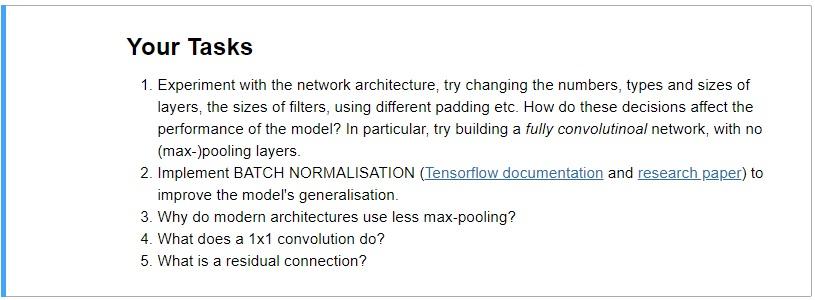
Your Tasks 1. Experiment with the network architecture, try changing the numbers, types and sizes of layers, the sizes of fil

NB: Please only do Tasks 1-2

Hair love

After doing Cultural Outtake: Hair Love respond to these questions plus 1 other student. This assignment is extra credit and is worth 10 points. 

#1 Traditions are important in families,
and in this film, one of the traditions
is that the mother does the hair of
her daughter. In your home who is in
charge of helping kids with their daily
routines? Why do you think that the
job is done by that person? What are
some struggles or challenges that
you remember while getting ready in
the morning? 

• #2 Beauty equals acceptance in our
culture much of the time, but is that
why you think it is so important for
Zuri to be able to walk out the door
feeling beautiful in the morning?

#3 Can you connect hair style and
culture? Does styling your hair a
certain way connect to history
or is it connected to the modern
interpretations of beauty?

#4 Does our culture in America have

a lack of representation of people
who also identify with their own
cultures and experiences?

• #5 The act of Braiding means bringing
things, like hair parts, together in
order to unify them. What are three
parts of the film that seem like they
are weaving together components of
the relationship for the family

HA405M6 Identify With Your Health Care Leadership Style


HA405-6: Assess your personal leadership style for healthcare management.

In this module, you will explore your leadership style and how you can use your unique skills to effectively manage a healthcare environment.

In a 2-page paper, discuss your leadership style, current weaknesses as a leader, and plans to improve your skills to develop into an ethical and effective healthcare leader. Include two (2) academic references and submit your assignment in APA format.

Requirements:

  • Identify one or two leadership styles (for the purpose of the assignment) that reflect how you lead.
  • Identify your current weaknesses based on the characteristics of the leadership styles.
  • Propose how you will improve your skills to develop into an ethical and effective healthcare leader. (For example, education, networking, associations, mentoring, and volunteering, etc.).
  • Include two (2) academic references.

Minimum Submission Requirements

  • This Assessment should be a Microsoft Word (minimum 2 page) document, in addition to the title and reference pages.
  • Respond to the questions in a thorough manner, providing specific examples of concepts, topics, definitions, and other elements asked for in the questions. Your paper should be highly organized, logical, and focused.
  • Your paper must be written in Standard English and demonstrate exceptional content, organization, style, and grammar and mechanics.
  • Your paper should provide a clearly established and sustained viewpoint and purpose.
  • Your writing should be well ordered, logical and unified, as well as original and insightful.
  • A separate page at the end of your research paper should contain a list of references, in APA format. Use your textbook, the Library, and the internet for research.
  • Be sure to cite both in-text and reference list citations where appropriate and reference all sources. Your sources and content should follow proper APA citation style. Review the writing resources for APA formatting and citation found in Academic Tools. Additional writing resources can be found within the Academic Success Center.
  • Your submission should:
    • include a cover sheet;
    • be double-spaced;
    • be typed in Times New Roman, 12 -point font;
    • include correct citations
    • be written in Standard English with no spelling or punctuation errors; and
    • include correct references at the bottom of the last page.

If work submitted for this competency assessment does not meet the minimum submission requirements, it will be returned without being scored.

Plagiarism

Plagiarism is an act of academic dishonesty. It violates the University Honor Code, and the offense is subject to disciplinary action. You are expected to be the sole author of your work. Use of another person’s work or ideas must be accompanied by specific citations and references. Whether the action is intentional or not, it still constitutes plagiarism.

Need someone good expert in Income Tax and all IRS forms as well


You are working as an accountant at a mid-size CPA firm. One of your clients is Bob Jones. Bob’s personal information is as follows: DOB: October 10, 1952 SSN: 444-00-4444 Marital Status: Single Home Address: 5100 Lakeshore Drive, Pensacola, FL 32502

 Bob has a very successful used car business located at 210 Ocean View Drive in Pensacola, Florida. Last year, you filed a Schedule C for Bob that had $1,200,000 in taxable income. The business will have an income growth rate of 10% per year over the next several years. Bob’s personal wealth, including investments in land, stocks, and bonds, is about $14,000,000. Last year, he reported interest income of $20,000 and dividend income of $6,000. The $14,000,000 includes land worth $9,000,000 that Bob bought in 1966 for $450,000. The stocks and bonds have a tax basis of $1,200,000 and they are currently worth $5,000,000. All of the investments have been owned for more than a year. In addition to his investments, Bob paid $140,000 for his home in 1972 and it is now worth $600,000. The used car business is currently valued at $53,000,000 including the land and building, which are worth $41,000,000. Bob’s tax basis in the land and building is $2,000,000 and $400,000, respectively. The inventory is worth $12,000,000, with a cost basis of $10,000,000; the remaining assets, which include office furniture and equipment, make up the remainder of the business’s total value. The office furniture and equipment are fully depreciated. Bob wants your professional advice regarding whether he should continue to operate as a sole proprietor or convert the business to a partnership, an S corporation, or a C corporation. Based on one of the business entities selected, Bob wants to include Mandy—his daughter—in the business as an owner and manager with a possibility of 40% interest. One of his concerns is what would happen to his business after he passes away. Mandy’s personal tax information is as follows: Mandy Jones DOB: June 30, 1990 SSN: 999-99-9999 Marital Status: Single Home Address: 5990 Langley Road, Pensacola, FL 35203

Required:

   F. Create a detailed tax planning proposal explaining how the client’s family can experience tax savings should the client pass away. Cite relevant governing rules and regulations. 

G. Illustrate a strategic plan that addresses the need for a will in handling the estate. Detail what happens to the business, land, and investments consistent with tax codes and regulations. Consider extending the plan to address the client’s estate tax, trust, and charitable contributions while minimizing estate tax. 

H. Recommend estate planning strategies consistent with tax codes and regulations for the purpose of reducing the taxable estate. Be sure to include gifting property to heirs in your response.

 I. Illustrate the best course of action if the client decides to leave the business in three years. Provide some advice to him should he decide to gift the business to his daughter or transfer the assets or common stock to her, depending on the business entity you have selected. 

J. Illustrate the best course of action if the client wishes to sell the business. Consider the tax consequences with regard to capital gains and losses, ordinary income issues, and selling an existing operating business.

Cite your sources

Project Deliverable 3: Database and Programming Design


This assignment consists of two (2) sections: a design document and a revised Gantt chart or project plan. You must submit both sections as separate files for the completion of this assignment. Label each file name according to the section of the assignment for which it is written. Additionally, you may create and / or assume all necessary assumptions needed for the completion of this assignment.

One (1) of the main functions of any business is to transform data into information. The use of relational databases has gained recognition as a standard for organizations and business transactions. A quality database design makes the flow of data seamless. The database schema is the foundation of the relational database. The schema defines the tables, fields, relationships, views, indexes, and other elements. The schema should be created by envisioning the business, processes, and workflow of the company.


Section 1: Design Document

1. Write a five to ten (5-10) page design document in which you:

a. Create a database schema that supports the company’s business and processes.

b. Explain and support the database schema with relevant arguments that support the rationale for the structure. Note: The minimum requirement for the schema should entail the tables, fields, relationships, views, and indexes.

c. Create database tables with appropriate field-naming conventions. Then, identify primary keys and foreign keys, and explain how referential integrity will be achieved.

d. Normalize the database tables to third normal form (3NF).

e. Create an Entity-Relationship (E-R) Diagram through the use of graphical tools in Microsoft Visio or an open source alternative such as Dia. Note: The graphically depicted solution is not included in the required page length but must be included in the design document appendix.

f. Explain your rationale behind the design of your E-R Diagram.

g. Create a Data Flow Diagram (DFD) through the use of graphical tools in Microsoft Visio or an open source alternative such as Dia. Note: The graphically depicted solution is not included in the required page length but must be included in the design document appendix.

h. Explain your rationale behind the design of your DFD.

i. Create at least two (2) sample queries that will support the organizational reporting needs.

j. Create at least two (2) screen layouts that illustrate the interface that organizational users will utilize.


Section 2: Revised Gantt Chart / Project Plan

Use Microsoft Project or an open source alternative, such as Open Project, to:

2. Update the Gantt chart or project plan (summary and detail) template, from Project Deliverable 2: Business Requirements, with all the project tasks.

The specific course learning outcomes associated with this assignment are:

  • Describe the various integrative functions and processes within the information systems area, including databases, systems analysis, security, networking, computer infrastructure, human computer interaction, and Web design.
  • Demonstrate the ability to evaluate organizational issues with integrative technological solutions.
  • Apply integrative information technology solutions with project management tools to solve business problems.
  • Use technology and information resources to research issues in information technology.
  • Write clearly and concisely about strategic issues and practices in the information technology domain using proper writing mechanics and technical style conventions.

Unit 1 Review Assignment


Please write in complete sentences. You should work on this assignment as you go through the assigned readings and chapters in your textbook. Avoid copying directly from the text. Your responses should be in your own words.

This assignment has been formatted in a Microsoft Word document for your convenience. Click the link U1 Review Assignment downloadto download this assignment in Word. Insert your responses directly under each question.

Chapter 12

  1. If it is true that “the quest for leadership is first an inner quest to discover who you are,” then what does this mean for aspiring leaders?
  2. What is meant by this statement: “Leadership is an affair of the heart.”
  3. Based on the information you’ve learned from reading these two chapters in your book, are leaders born or is leadership learned? Support your opinion.

Chapter 1

  1. What are The Five Practices of Exemplary Leadership? Briefly describe each practice.
  2. How did Kouzes and Posner originally develop their leadership model?
  3. What is meant by the phrase “Leadership is a relationship”?
  4. According to Kouzes and Posner’s research, what are the four characteristics that people most look for and admire in a leader, someone whose direction they would willingly follow? Briefly describe each characteristic.
  5. What is the First Law of Leadership? What does it mean for leaders and would-be leaders?
  6. What is meant by this statement? “Credibility is the foundation of leadership.”
  7. What does DWYSYWD, the Second Law of Leadership, mean? Why does it matter?

Grading Criteria

Each question is worth 10 points. You will be primarily graded on the accuracy and thoroughness of your responses and on your ability to communicate; however, the rubric below will be applied to grade this assignment:

Any intentional or unintentional plagiarism may result in an F in this assignment and an F in the course. If you take information from the text (and you will), you must cite the book as your resource at the end of your file. Include parenthetical citations in your answers that give the page number from your book where you got this information. If you take text directly from our book, you must put this text in quotation marks and provide the page number in a parenthetical citation.

Upload Instructions:

Select the Submit Assignment button to the right. Click Choose File, located in the File Upload box. Navigate to your file location. Once the file is located, select it and then select the Open button. Click Submit Assignment to complete the upload process.