Action Research Case Study

Keep in mind, the research and development for this assignment is the foundation for the consulting proposal that you will develop during the Week 5 paper. Review the following case studies and select one to examine and apply the theoretical concepts and methods used during an OD intervention.

Review Case Study 1 and Case Study 2 below using the tabs.

Case Studies

Case Study 1: Blaze Mining Case Study

Organizational Problem:

Blaze Mining is a mid-size, family-owned oil and mining company located in Louisiana. Over the past 10 years, leadership of the company has fractured and become antagonistic. Non-collaborative internal teams have caused great damage to the management and operation of critical functions within the organization. Recently, a new CEO joined the organization and was stunned by the discord within the leadership team and its effect on the bottom line.

Organizational Design:

Blaze Mining is family-owned and managed. There are multiple divisions and departments pertinent to the type of operation occurring: Mining, Oil, Off Shore, Human Resources (HR), Finance, Education, and Safety. Each section is led by a family member and a personally selected team. The CEO is the overseer of the company.

Challenge and Request Criteria:

For the company to survive, the problems within the leadership team must be identified and addressed in a professional manner. The CEO of Blaze Mining is requesting an OD intervention to interact with the leadership group and develop a cohesive team focused on the success of the organization. The intervention is to include

  • three workshop sessions, once a month, for three months;
  • specialized intervention with each division/department; and a wrap-up session with all stakeholders

Case Study 2: City Center Hospital Case Study

Organizational Problem:

Center City Hospital is a large outpatient surgery center in a mid-size urban area of Kansas. The CEO, Director of Nursing (DON), and the HR manager are concerned with a morale issue amongst the nursing staff of the organization. During the past year, the hospital has been trying to change the culture to become more profit and patient-centered.

Organizational Design:

Full-time staffing of the hospital is operational. This includes the CEO, DON, Human Resources Management (HRM), Finance, Risk Management, and Unit Managers for each section of the surgery center. Nursing staff within the center is outsourced and nurses are hired on as conditional permanent staff. The doctors are independent contractors with the hospital and are on yearly contracts.

Challenge and Request Criteria:

The CEO, DON, and the HRM believe the morale of nurses is at an all-time low and the relationship between doctors, unit managers, and nurses is damaging to the mission of the hospital. The CEO is concerned about losing physicians due to the lack of leadership skills displayed by the unit managers. The unit managers are concerned about the stress level for the nurses and blame the arrogant behavior of the physicians as the cause of stress.

The CEO, DON, and HRM request an OD intervention for all internal managers with the intent of developing a common focus of leading a united team. The leadership team requires that this be addressed in a one-day workshop and that a visible improvement be seen over the next 12 months.

As defined by the leadership team, the intervention

  • is to develop stronger leadership skills within the unit manager staffing, and must result with visible improvement over the subsequent 12 months.

The paper must be four to five pages in length, and include level headings to lead the reader through the specific areas of content. Level headings also provide the reader with an outline to ensure all areas of the project are covered. You may refer to the Introduction to APA (Links to an external site.) webpage, and read the information under “Level Headings” for assistance on level headings. The paper must include the course textbook as a reference, as well as four additional scholarly, peer-reviewed, and/or credible sources to support the content of the paper.

HCM 337 DB2

400-600 words, APA 6, in-text citation, Cite at least two (2) scholarly online references published within the last 5 years. 

Select 2 of these and discuss why they are important for building effective provider/patient relationships and maintaining a standard of care.  Are there other guidelines you would add to this list?  Use examples based on your experiences. 

Assignment Description 

The following guidelines for healthcare practitioners are helpful for staying within the scope of practice while operating within the law and policy of any healthcare facility. 

  • Practice within the scope of your training and capabilities. 
  • Use the professional title commensurate with your education and experience. 
  • Maintain confidentiality 
  • Prepare and maintain health records. 
  • Document accurately 
  • Use appropriate legal and ethical guidelines when releasing information. 
  • Follow an employer’s established policies dealing with the health care contract. 
  • Follow legal guidelines and maintain awareness of health care legislation and regulations. 
  • Maintain and dispose of regulated substances in compliance with government guidelines. 
  • Follow established risk management and safety procedures. 
  • Meet the requirements for professional credentialing. 
  • Help develop and maintain personnel, policy, and procedure manuals. 

Select 2 of these and discuss why they are important for building effective provider/patient relationships and maintaining a standard of care.  Are there other guidelines you would add to this list?  Use examples based on your experiences. 

Week7-8 Activity Principle of Finance

Week 7

For this week’s activity, go to the Strayer library search page and use your textbook to answer the following questions using the Week 7 Investments Template [DOCX].

  1. Describe the differences among the following three types of orders: market, limit, and stop loss. Provide examples of each in your own words.
  2. What is a short sale of stock? Provide an example in your own words.
    • Use your textbook to define the term short sale as it pertains to stock.
  3. Describe buying on margin. Provide an example in your own words.
  4. Why is it illegal to trade on insider information? Provide an example in your own words.

Week 8

Finance in Business Activity

Instructions

Note: Watch the Excel tutorial videos linked in this week to learn how to use Excel before attempting the activity. You can use the template provided or you may create your own template based on the one provided.

Complete the following scenario using the templates provided:

  1. Select one U.S. publicly traded company and review its most recent annual report. (You may use one of the three companies you selected for your Stock Journal assignment.)
    • Use the Week 8 Finance in Business Excel Template [XLSX] provided to report assets, liabilities, equity, revenue, and net income for your selected company.
      • Note: There are locked cells in the Excel template. The cells have been locked to prevent the formulas from being disturbed. The cells that you will need to use to complete this assignment are not locked. You may create your own templates, however it is recommended that you use the templates provided.
  2. Determine changes in assets, liabilities, and equity.
  3. Determine changes in total revenue and net income.
  4. Describe the changes from the current and prior years in each of these key areas and whether the changes would be positive or negative from an investor/stockholder’s view.
  5. Go to the Strayer library search page to locate and incorporate at least two quality sources into this assignment.
  6. Submit two documents for your Annual Report activity submission by uploading both documents at the same time in the submission area:

JD:Final Project Guidelines

  Please see the attachment for the Rubric

MMPA 6832: Terrorism: Legislation and Policy

Final Project Guidelines

For the Final Project, you are asked to develop a proposal to improve US counterterrorism policy in a specific area (e.g., detainee affairs, homeland defense, intelligence etc.). The proposal you develop must address improvements needed to structures, legislation, regulations, and strategies used in counterterrorism efforts. 

The Final Project must include: 

· A brief description of the policy area (e.g. – detainee affairs, homeland defense, intelligence etc.) you selected. 

· An explanation for why you selected the policy area you did. That is explain the problems you wish to address, including the relevant history, background, actors, and salient issues, as well as gaps in existing policy, structures, legislation, and regulations.

· A explanation of specific improvements you would make to existing policies, structures, legislation, and regulations related to the policy area you selected

· An explanation of the strengths and limitations of your proposed improvements. Be sure to include how you could compensate for the limitations.

· An explanation of the challenges associated with implementing your proposed improvements. Be sure to discuss bureaucratic and organizational impediments.

Your Final Project must be presented as a 6 pages (not including references or title page), double-spaced, APA-formatted project in the form of a paper that is submitted by Day 7 of Week 11. See Week 11 for specific instructions for submission.

You may wish to use the above bulleted items as the basis for topic headings throughout your paper 

Module 04 Written Assignment – The Zappos Culture


Module 04 Content

  1. Zappos is a company that is known for its unique organizational culture and commitment to delivering a memorable customer experience. For this assignment, research Zappos to learn what makes its company culture and service so different from other companies.

    In a 1-2 page paper, describe the characteristics of the Zappos culture and explain how the employees provide excellent service to customers. Identify one example that demonstrates how Zappos empowers its employees to deliver great customer service.

    Your submitted assignment should be proofread for correct spelling, grammar, and punctuation.

    Be sure to follow APA formatting, and include both in-text citations and a references page. Provide at least one reference and in-text citation (other than the Zappos.com website) for your paper.

    For APA guidelines, go to the Resources tab within the course.

    Submit your completed assignment by following the directions linked below. Please check the Course Calendar for specific due dates.

    Save your assignment as a Microsoft Word document. (Mac users, please remember to append the “.docx” extension to the filename.) The name of the file should be your first initial and last name, followed by an underscore and the name of the assignment, and an underscore and the date. An example is shown below:

    Jstudent_exampleproblem_101504

Python Neural Networks diabetes

 USE Jupyter Notebook

Given Code: ‘Part of answer’ but incomplete…..

# Importing libraries
import pandas as pd
import numpy as np
from sklearn.neighbors import KNeighborsClassifier
from sklearn.tree import DecisionTreeClassifier
from sklearn.model_selection import train_test_split
from sklearn import metrics


# Loading the dataset
data = pd.read_csv('diabetes.csv')

# Separating features and target
features = data[['Pregnancies', 'Glucose', 'BloodPressure', 'SkinThickness', 'Insulin', 'BMI', 'DiabetesPedigreeFunction', 'Age']]
target = data['Outcome']

# Splitting training and testing data in the ratio 70 : 30 respectively
x_train, x_test, y_train, y_test = train_test_split(features, target, random_state=0, test_size=0.3)


# KNN model
modelKNN = KNeighborsClassifier()

# Train the model
modelKNN.fit(x_train, y_train)

# Predict test set
y_pred_knn = modelKNN.predict(x_test)

# Print accuracy of the KNN model
print(modelKNN.score(x_test,y_test))

# Print Confusion matrix
print(metrics.confusion_matrix(y_test, y_pred_knn))

# Print Classification Report for determining precision, recall, f1-score and support of the model
print(metrics.classification_report(y_test, y_pred_knn))


# Decision Tree model
modelDT = DecisionTreeClassifier()

# Train the model
modelDT.fit(x_train, y_train)

# Predict test set
y_pred_dt = modelDT.predict(x_test)

# Print accuracy of the Decision Tree model
print(modelDT.score(x_test,y_test))

# Print Confusion matrix
print(metrics.confusion_matrix(y_test, y_pred_dt))

# Print Classification Report for determining precision, recall, f1-score and support of the model
print(metrics.classification_report(y_test, y_pred_dt))

Please do the data cleaning and feature selection…

Please use the given code/layout given below original question….

ORIGINAL QUESTION:

“”for more info check original .ipynb file””

Fill out the code below so that it creates a multi-layer perceptron with a single hidden layer (with 4 nodes) and trains it via back-propagation. Specifically your code should: 

  1. Initialize the weights to random values between -1 and 1
  2. Perform the feed-forward computation
  3. Compute the loss function
  4. Calculate the gradients for all the weights via back-propagation
  5. Update the weight matrices (using a learning_rate parameter)
  6. Execute steps 2-5 for a fixed number of iterations
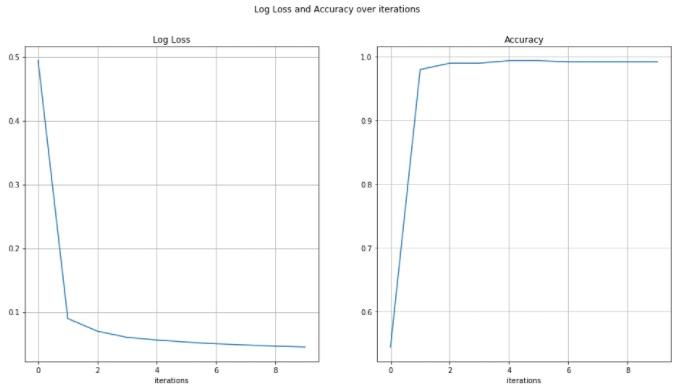
  7. Plot the accuracies and log loss and observe how they change over time

First, initialise the parameters. This means determining the following:

Size of the network

Hidden layers (or a single hidden layer in this example) can be any size. Layers with more neurons are more powerful, but also more likely to overfit, and take longer to train. The output layer size corresponds to the number of classes.

Number of iterations

This parameter determines how many times the network will be updated.

Learning rate

Each time we update the weights, we do so by taking a step into the direction that we calculated will improve the accuracy of the network. The size of that step is determined by the learning rate. Taking small steps will slow the process down, but taking steps that are too large can cause results to vary wildly and not reach a stable optimum.

Next, fill in the code below to train a multi-layer perceptron and see if it correctly classies the input.

in[]# Reshape y
y =

# Initializing weights

W_1 =
W_2 =

# Definining number of iterations and learning rate(‘lr’)
num_iter =

learning rate =

in[]# Creating empty lists for loss values(error) and accuracy
loss_vals, accuracies = [], []

for j in range(num_iter):
# Do a forward pass through the dataset and compute the loss
 

# Decide on intervals and add on the current loss and accuracy to the respective list

# Update the weights

in[]# Plot the loss values and accuracy

Log loss and Accuracy over iterations Log Loss Accuracy 05 10 04 09 03 OB 02 07 01 06 0 iterations iterations

Higher number of iterations and lower learning rate seems to improve accuracy


Paris Street; Rainy Day Gustave Caillebotte 1877 5 PAGE ANALYSIS PAPER

Overview:

For this Historical Essay, you will provide a formal analysis and the historical context for a work of art in the collection of the Art Institute of Chicago. You may choose a work from any time period, medium, geography or culture. Due to COVID, you are not required to see the work of art in person. The museum documents its collection through its database, including high resolution images and information regarding the artist, date, dimensions, and materials used in the artwork.

Start here to examine works of art in the Art Institute’s collection: https://www.artic.edu/visit-us-virtually

If you are interested in the painter El Greco, there is a virtual tour of his painting The Assumption from 1577 here: https://www.artic.edu/interactive-features/the-assumption-of-the-virgin A part of the Art Institute’s permanent collection.

Select your object and post on assigned Discussion Board by Monday, April 19th, 11:30PM

Download a photograph from the Art Institute website and simply post it with the artist’s name, title, and date on the Discussion Board. Once everyone posts their objects, I will suggest some sources and offer comments, which I hope will help you get started. By selecting your object for the Historical Essay by the beginning of week four gives you time to do research and complete the paper by the end of the quarter. This assignment is not graded, but five points will be deducted from the final paper if not completed.

Take a careful look at your selected object online and make notes based on the prompts for the assignment listed below.

Once you have compiled your observations and researched your object, write a five to six page paper based on the questions asked below. Be sure the text is double-spaced and uses 12-point font. 

Four research sources are required. (Details of how to find materials can be found below.) When you paraphrase or directly quote any sources, you must provide a citation. (Formatting guidelines provided below)

Research Sources:

Do not use Google searches for research. Wikipedia may be used to track down sources, but cannot be used as a source in its own right. Blogs, commercial gallery websites, and the Art Story, are not considered credible sources. Here is a list of recommended resources available at DePaul.

  1. The Art Institute’s website devoted to its collections (http://www.artic.edu/aic/collections/). You can do a search for the artist you have chosen. When you have found the work you have selected, click on it and any bibliography pertinent to the work will be revealed under “Publication History.” There may also be museum label text included in the database entry.
  2. Online scholarly catalogues from the Art Institute of Chicago. See: https://www.artic.edu/digital-publications for a complete list of texts.
    1. Grove Art Online, Benezit Dictionary of Artists, Oxford Art 
    2.  Catalogues from the Art Institute of Chicago. (Do search on online catalogue with Art Institute of Chicago as author)
      1. The Art Institute of Chicago, The Essential Guide. Chicago: The Art Institute, 2003. R.708.17311 A784a2003 (Chicago Collection, Richardson Library)
      2. Master Paintings in the Art Institute of Chicago (Chicago: The Art Institute, 1988). R750.74 A784m 1988. (Chicago Collection, Richardson Library)
      3. The Art Institute of Chicago, Twentieth-Century Painting and Sculpture (Chicago: The Art Institute, 1996). R709.4 W876a 1996 (Chicago Collection, Richardson Library)
      4. African-Americans in Art: Selections from the Art Institute of Chicago (Chicago: The Art Institute, 1999). R704.0396073 A784a 1999 (Chicago Collection, Richardson Library).
      5. Asian Art in the Art Institute of Chicago. (Chicago: The Art Institute, 1993). R.708.17311 A784a1993 (Chicago Collection, Richardson Library)
      6. Italian Paintings Before 1600 in the Art Institute of Chicago. (Chicago: The Art Institute, 1993). R.759.5074 A784i1993 (Chicago Collection, Richardson Library)
      7. Surrealist Art, The Lindy and Edwin Bergman Collection at the Art Institute of Chicago (Chicago: The Art Institute, 1997). R709.04 A232 S1997 (Chicago Collection, Richardson Library)
    3. Books devoted to the artist you are studying. 

Other resources for writing art history papers (posted as pdfs below):

Be sure to draw on appropriate art historical vocabulary utilized in lecturettes and discussions, as well as this chapter: Anne D’Alleva, Look! The Fundamentals of Art History (Upper Saddle River, New Jersey: 2004), chapter 2.

Also see: Sylvan Barnet, A Short Guide to Writing About Art (Upper Saddle River, NJ: 2011), 3rd edition, 46-68. This chapter offers a sample formal analysis essay, which may be useful for students new to this type of assignment.

Questions to be addressed in the Historical Essay:

  • Begin your paper with an introduction, including a thesis statement. What is the title of the work of art you are writing about? Who is the artist? What year was it created? What will we learn about your selected object from the Art Institute of Chicago?
  • Please note that the biography of the artist should only be addressed if pertinent to your chosen artwork, otherwise it should not be discussed.
  • Formal Analysis:
    • The Formal Analysis is equivalent to a written “tour” of a work of art. You want to provide the most vivid description possible. Walk the reader through the work of art logically, for instance, describing top to bottom or left to right. Be sure to indicate precisely where forms and shapes are located in the composition.
    • In addition, please consider:
      • Analyze the work itself. How does the art “work?”  That is, what details in the piece are used to convey its meaning? Consider how these details function by themselves and together as a whole.
        • Paintings, Drawings, and Etchings: If a representational image, what specifically is depicted? Where precisely are the forms placed in the composition: foreground, middle ground, background? If an abstract or nonobjective work, how are the forms and shapes arranged in the composition? Discuss the precise techniques and materials used (e.g. oil painting, etching, lithograph, etc.) How does the artist use color?  Are there stark contrasts or is it blended?  Are there symbolic meanings behind the color choices? How does the artist use line?  Are forms linearly arranged or disordered? What is the scale? How does the scale of the work impact the viewer’s interaction?
        • Sculpture and three-dimensional artworks: What is the medium of the piece, and how does it affect the viewer’s impression? (For example, stone gives a sense of permanence and strength.) Discuss the precise and materials techniques used. (e.g. carved marble, modeled from clay, cast in bronze, created from found objects, etc.) What was the purpose of this piece?  In what setting was it originally placed? Is the piece unusually large or small? Is the piece representational or abstract?  Is the artist exploring forms or space within forms? What is the subject of the sculpture?  What type of impression does it give of the subject? What is the scale? How does the scale of the work impact the viewer’s interaction?
  • Include additional historical information. What country or region was it made in? Does it belong to a particular movement, age or school of thought? Does it have an influential patron? Is this work typical or atypical of its period, style or artist?  What does this work tell us about the era in which the artist worked? Does it reflect significant social, political and/or cultural events of that time period? Research will be required to answer these questions.
  • Discuss your interpretation of this work. What do you think the subject is? What kind of statement is the artist trying to make? How do art historians and critics interpret your selected work of art? Are there issues that these authors have not taken into account? Research will be required to answer these questions.
  • Offer a persuasive conclusion to the paper. 
  • Make sure that all material from the four required research sources that is paraphrased and/or directly quoted from texts is cited and a Works Cited page is included at the end of the paper. For formatting MLA citations see: https://owl.purdue.edu/owl/research_and_citation/mla_style/mla_formatting_and_style_guide/mla_in_text_citations_the_basics.html
  • For the Works Cited page see: https://owl.purdue.edu/owl/research_and_citation/mla_style/mla_formatting_and_style_guide/mla_works_cited_page_basic_format.html 
  • Carefully proofread your text. For example, use spell-check and thesaurus options. You can also read your paper out load to catch any errors. Poor grammar and spelling will be penalized.

Basic Guidelines for Writing Art History Papers:

1. Titles of works of art and exhibition titles should be italicized or underlined. Students should label illustrations as: Artist, Title, date. Medium and scale. Bibliographic source for image should be given as well.

  • For example: Fig. 1. Frida Kahlo, Self-Portrait with Thorn Necklace and Hummingbird, 1940. Oil on hardboard, 51 x 38.5cm. Reproduced in Frida Kahlo, Emma Dexter and Tanya Barson, eds. London: Tate Gallery, 2005, figure 37.

3. If you are defining an art historical term, such as Impressionism, do not use a standard dictionary definition, use your textbook, another art historical text or the Oxford Art Online database.

4. When first discussing an illustrated image, indicate its presence in the text by adding (Fig. #) at the end of a sentence that introduces the image.

5. Artworks should be discussed in the present tense.

6. The voice of scholars from secondary sources should be discussed in the past tense. For example, Dexter argued that Kahlo’s images….

7. Avoid the phrase “piece of art work.” Instead, be specific about the medium as much as possible. This painting, this sculpture, etc.

Marketing Plan Part C


Part C: Your Marketing Plan

Overview

For this assignment, you will conclude your marketing plan by developing your hypothetical company’s pricing and distribution strategies, and integrated marketing communications plan.

Note: You should make all assumptions needed for the completion of this assignment.

Instructions

Create the third part of your marketing plan in 8–12 pages:

  1. Describe or list the feedback you received on Part B of your marketing plan. Explain how you will use the feedback to improve your plan.
  2. Develop the company’s pricing and distribution strategy.
  3. Develop the integrated marketing communications plan most relevant for your product or service and audience. Develop your message strategy. Develop your media strategy.
  4. Develop your public relations, sales promotion, and personal selling plan most relevant for your product or service and audience.
  5. Develop your online and direct marketing plan most relevant for your product or service and audience.
  6. Develop your social-responsibility or cause-related marketing plan most relevant for your product or service and audience.
  7. Use at least three academic resources that address sustainability and monitoring of effective marketing plans and determine the applicability for your hypothetical company. These resources should be industry specific and relate to your chosen product or service.
  8. Use the Part C Marketing Plan Template [DOCX] to complete the assignment.

english paper


Length: 6-8 pages

*Papers submitted after classes have ended will not be accepted.

Social justice is the view that all people deserve equal economic, political and social rights and opportunities. Social justice isn’t an “us versus them” mindset; instead, it is a “we are – or should be- in this together” attitude. To understand the intricacies of social justice and create social change, your final essay prompt asks you to:

– Work closely with any two personal narratives from Michelle Tea’s Without a Net. From these, you will determine a common, social justice issue. These will be your primary sources.

– Include three or more secondary sources to support your thinking. See below for acceptable means of research.

– Form a thesis based on the information you gather from all of your sources. As we have discussed this semester, your thesis (at first) will be a working one as you investigate a social justice issue. The deeper your analysis, the better.

For example, one common thread between primary sources might be the stigmatization of teenage mothers. Looking at this theme within a larger social context, one might argue that because of the stigmatization of teenage mothers, women haven’t been given the necessary medical treatment they deserve; therefore teen moms suffer future illnesses that may continue to be ignored. Had they been given the proper treatment primarily, many of these women’s health issues could have been avoided. 

Secondary sources may include but are not limited to:

Ø Scholarly articles

Ø Interviews (those you conduct or view)

Ø Documentaries

Ø Newspaper articles

Ø Graphs

Ø Maps

Ø Charts

Ø Sound Recordings

Ø Art of any kind

In your essay, be sure to:

– cite and analyze passages from the text for support.

– underline your thesis.

– offer a title for your essay.

– include the MLA style of documentation. (Consult Bb for appropriate MLA style of citation and documentation).

– proofread carefully.

– submit your essay onto Turnitin.com (user info. is on Bb).

Below are social justice topics you might find of interest, but these are optional.

– Civil Rights and Racial Discrimination

– Gender Diversity

– LBGTQ+ Issues

– Income Inequality

– Poverty and Homelessness

– Immigration Stresses

– Health Care Availability

– Awareness Through Education

– Diversity and Inclusion 

– Political and Social Injustice

– The Importance of Rebellion

– Injustice in Treatments of Disabled Folks in America

– Critical Analysis of Recent Movements (#metoo, BLM, and so on)

– Poverty

Pre-writing:

Use the rest of this sheet to brainstorm connective threads you can discern between any two personal narratives from Tea’s anthology.

Network Assignment


Assignment Details

Part 1

For many thousands of years, the primary method of communication was for people to physically gather together to share ideas and discuss concerns. In today’s technology driven world, huge numbers of people gather together without ever directly seeing each other. This is done through social media. Social media is known to produce great changes on how individuals and communities communicate and perceive each other.

Complete the following in a minimum 1-page response:

  1. Briefly, define social media such as Google+®, Twitter®, Pinterest®, LinkedIn®, and Facebook® and how it differs from traditional media. In addition, how has social media impacted the workplace?
  2. Given the increased prevalence of social media, how has your personal perspective of multiculturalism and diversity been impacted?
  3. Select an organization you belong to. How do you think your perspective has impacted that organization? How do you feel that others in the organization have been impacted?

Part 2

As an information technology professional, you are faced with opposing perspectives on ethical issues in your daily work. Research opposing perspectives on ethical issues faced in the Information Technology field as it pertains to networking. An example might be the difference in perspectives of utilizing biometrics for authentication.

Take into consideration the opposing perspectives of different technologies, as it relates to ethics and complete the following in a minimum 1-page essay.

  1. Identify the opposing perspective you have chosen.
  2. Explain the ethical implications that are inherent with both sides of the issue.
  3. Given the ethical implications on both sides of the issue, evaluate the ethical implications on both sides.
  4. Provide your perspective on how you might apply the issue in a work situation.